📋 Table of Contents
- 1. Understanding Tax Exemptions Under the Income Tax Ordinance 2001
- 2. Visual Infographic: Allowances & Tax Exemption Classifications
- 3. The Statutory Tax-Free Threshold: Rs. 600,000 Annual Salary
- 4. Medical Allowance vs. Hospitalization Reimbursement (Clause 139)
- 5. Provident Fund, Gratuity & Pension Exemptions
- 6. Conveyance Allowance & Company-Maintained Car Rules
- 7. High-Value Tax Credits: Section 61 Donations & Section 63 VPS
- 8. How to Adjust Advance Taxes (Mobile, Electricity, Vehicle) in Iris
- 9. 4 Common Payroll Mistakes That Trigger FBR Scrutiny
- 10. Frequently Asked Questions (FAQs)
With progressive salary tax rates reaching as high as 35% in Pakistan, maximizing legitimate statutory exemptions is the smartest way for salaried professionals to optimize their net take-home income. The Income Tax Ordinance 2001 contains specific clauses within its Second Schedule (Exemptions and Tax Concessions) that permit employees and employers to structure payroll compensation efficiently. This definitive guide details every legally recognized exemption, tax rebate, and allowance threshold available to Pakistani employees.
1. Understanding Tax Exemptions Under the Income Tax Ordinance 2001
Under Pakistani tax law, an "exemption" refers to income components that are legally excluded from your gross earnings before computing taxable income. Unlike tax evasion (which is illegal concealment of income), utilizing statutory allowances and tax credits is recognized as legitimate tax planning under Chapter III of the Ordinance.
The statutory framework differentiates between:
- Total Exemptions: Income items completely excluded from taxation (e.g., medical hospitalization reimbursement against verified invoices).
- Conditional / Threshold Exemptions: Income exempt only up to a prescribed statutory limit (e.g., medical allowance capped at 10% of basic pay).
- Direct Tax Credits: Rebates that directly reduce your final calculated tax liability (e.g., donations under Section 61 and pension investments under Section 63).
2. Visual Infographic: Allowances & Tax Exemption Classifications
The reference infographic below categorizes common salary components into Tax-Free, Fully Taxable, and Direct Tax Credit buckets:
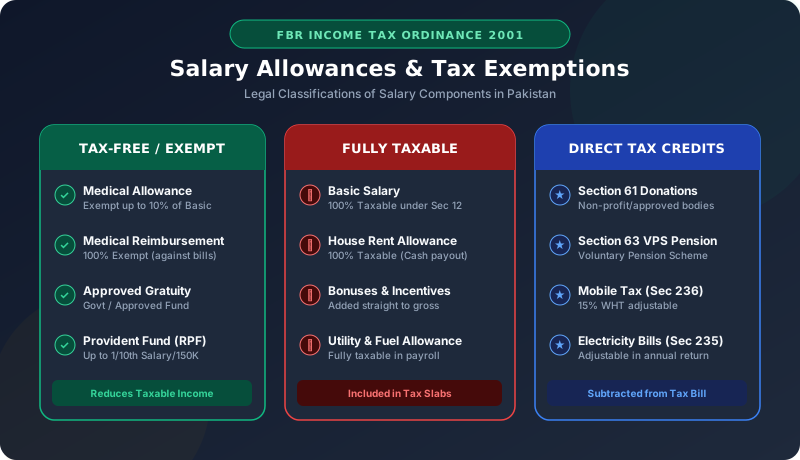
3. The Statutory Tax-Free Threshold: Rs. 600,000 Annual Salary
The foundational pillar of Pakistan's salary tax structure is the Basic Exemption Threshold defined in Division I, Part I of the First Schedule:
Importantly, if your salary slightly exceeds PKR 600,000 (for example, PKR 650,000 per year), tax is NOT applied to the entire PKR 650,000. Under the progressive slab mechanism, the first PKR 600,000 remains 100% tax-free, and you only pay 5% tax on the incremental PKR 50,000 (which equals just PKR 2,500 for the entire year, or PKR 208 per month).
4. Medical Allowance vs. Hospitalization Reimbursement (Clause 139)
Medical compensation is the most significant payroll exemption available to private and public sector employees. However, it is governed by strict statutory conditions under Clause (139), Part I of the Second Schedule:
Condition A: Cash Medical Allowance (10% Cap)
- If an employment contract provides a regular cash medical allowance without requiring medical bills, it is tax-exempt up to 10% of the employee's Basic Salary.
- Example: If Basic Salary is PKR 100,000 and Medical Allowance is PKR 15,000:
• Exempt limit (10% of Basic) = PKR 10,000
• Taxable excess = PKR 15,000 - PKR 10,000 = PKR 5,000 (added to taxable salary).
Condition B: Medical Reimbursement Against Actual Bills (100% Tax-Free)
- If the employer provides reimbursement for actual medical treatment, diagnostic tests, consultations, or hospitalization incurred by the employee or dependent family members, the entire reimbursed amount is 100% tax-exempt without any upper monetary ceiling.
- Compliance Requirement: To qualify, the reimbursement must be explicitly mentioned in the employment terms, and the employee must submit original hospital/pharmacy receipts containing the National Tax Number (NTN) of the healthcare provider.
5. Provident Fund, Gratuity & Pension Exemptions
Long-term retirement benefits enjoy substantial statutory protection under the Income Tax Ordinance:
Recognized Provident Fund (RPF)
For provident funds formally approved by the Commissioner Inland Revenue (Sixth Schedule, Part I):
- Employee Contribution: Deducted from net salary (after tax).
- Employer Contribution: Exempt from tax up to 10% of basic salary + dearness allowance or PKR 150,000 per year, whichever is lower. Any excess contribution is treated as taxable perquisite.
- Interest Credited: Accumulated annual interest on the provident fund balance is exempt up to a rate of 16% per annum or one-third of basic salary, whichever is greater.
- Final Withdrawal on Retirement: Accumulated balance received upon retirement, resignation, or termination is 100% exempt from income tax.
Approved Gratuity Funds
- Government / Statutory Bodies: Gratuity received by civil servants, armed forces, and statutory corporation employees is 100% tax-exempt without any monetary limitation.
- FBR-Approved Private Gratuity Funds: Gratuity paid from an approved fund under the Sixth Schedule is completely tax-exempt.
- Unapproved Gratuity Schemes: If gratuity is paid from an unapproved scheme, it is exempt up to PKR 75,000 or 50% of total gratuity, whichever is less.
6. Conveyance Allowance & Company-Maintained Car Rules
Corporate mobility benefits are evaluated according to specific valuation mechanisms under Section 13(3):
- Cash Travel / Fuel Allowance: If paid in cash as part of monthly payroll, it is 100% taxable.
- Company-Provided Motor Vehicle (Partly for Personal Use): If your employer provides a company-owned or leased car for both official duties and private personal use, an amount equal to 5% of the vehicle's original purchase cost (or fair market value at commencement of lease) is added annually to your taxable salary.
- Exclusively Official Use: If a vehicle is dedicated exclusively to official field operations with mileage logs maintained, zero perquisite value is added to taxable salary.
7. High-Value Tax Credits: Section 61 Donations & Section 63 VPS
Unlike allowance exemptions (which reduce taxable income), a Tax Credit reduces your final calculated tax rupee-for-rupee. Two primary credits exist for salaried employees:
1. Charitable Donations (Section 61)
Donations made to universities, government relief funds, public hospitals, and non-profit institutions approved under Section 2(36) or listed in the Second Schedule qualify for a tax credit.
Tax Credit = (Actual Annual Tax ÷ Taxable Income) × Eligible Donation AmountMaximum Eligible Limit: Up to 30% of taxable income for individuals. Donations must be made via banking channels (cheque/online transfer); cash donations do not qualify.
2. Voluntary Pension Scheme (VPS) Contributions (Section 63)
Salaried professionals investing in SECP-regulated Voluntary Pension Schemes (VPS) managed by licensed asset management companies enjoy a direct tax credit of up to 20% of annual taxable income. This is one of the most powerful legal tax shelters in Pakistan for high-income corporate professionals.
8. How to Adjust Advance Taxes (Mobile, Electricity, Vehicle) in Iris
Throughout the year, advance withholding taxes are automatically deducted from your daily living expenses. Salaried taxpayers can claim every single rupee of these deductions against their annual salary tax when filing their return on the FBR Iris portal:
Adjustable Advance Taxes on FBR Iris Return:
- Mobile Phone Advance Tax (Section 236): A 15% advance tax is deducted on every mobile card recharge, easyload, and postpaid invoice. You can download the annual tax certificate directly from your telecom operator app (Jazz World, My Zong, My Telenor, My Ufone).
- Electricity Bills (Section 235): Advance withholding tax charged on domestic electricity bills where monthly billing exceeds threshold limits.
- Vehicle Registration & Token Tax (Section 231B/234): Annual motor vehicle token tax and registration withholding taxes paid to provincial excise departments.
- Banking & International Card Transactions (Section 236Y): Advance withholding on international card payments and streaming subscriptions.
When submitting your Iris return, these deductions are entered under the Adjustable Tax tab. If your adjusted advance taxes exceed your final tax liability, FBR creates a formal Tax Refund Credit in your account that can be carried forward or refunded!
9. 4 Common Payroll Mistakes That Trigger FBR Scrutiny
- Arbitrary Allowance Labeling: Splitting gross salary into fake allowances (e.g., "Dress Allowance" or "Entertainment Allowance") to evade tax. FBR treats all non-specified allowances as 100% taxable.
- Claiming Medical Exemption Without Basic Salary Proportion: Setting medical allowance at 30% or 40% of salary and claiming the entire amount as exempt. The legal exemption is strictly capped at 10% of basic pay.
- Cash Donations for Tax Credit: Donating cash to charities and attempting to claim Section 61 credit. FBR strictly disqualifies any donation not backed by crossed banking instruments.
- Failure to Maintain Medical Receipts: Claiming full hospitalization reimbursement without retaining formal NTN-verified invoices during tax audit proceedings.