📋 Table of Contents
- 1. Who Qualifies as a "Salaried Individual" Under FBR Law? (The 75% Rule)
- 2. Gross Salary vs. Taxable Salary: Allowances Breakdown
- 3. Visual Salary Tax Calculation Workflow
- 4. 4-Step Mathematical Process to Calculate Salary Tax
- 5. Current FBR Progressive Salary Tax Slabs Schedule
- 6. Real-Life Case Study #1: Calculating Tax on Rs. 125,000 Monthly Salary
- 7. Real-Life Case Study #2: Calculating Tax on Rs. 350,000 Executive Salary
- 8. Employer Withholding Tax Under Section 149: How Payroll Deducts It
- 9. Legal Methods to Reduce Your Salary Tax in Pakistan
- 10. Frequently Asked Questions (FAQs)
Understanding how income tax on salary is calculated in Pakistan is essential for every corporate professional, government officer, and private sector employee. Under the Income Tax Ordinance 2001 and the updated Finance Act 2025–2026, salaried individuals are taxed under a progressive slab mechanism. This comprehensive guide walks you through the exact mathematical formulas, legal exemptions, pay slip breakdowns, and real-world calculation examples so you can verify your monthly salary deduction down to the exact rupee.
1. Who Qualifies as a "Salaried Individual" Under FBR Law? (The 75% Rule)
Before computing your tax liability, you must verify whether the Federal Board of Revenue (FBR) classifies you under the "Salaried Individual" schedule or the "Non-Salaried / Business Individual" schedule. The difference in tax rates between these two categories is massive: salaried taxpayers enjoy a lower progressive tax rate structure compared to sole proprietors or partnership partners.
Under Section 2(62) and Division I, Part I of the First Schedule to the Income Tax Ordinance 2001, an individual is legally treated as salaried if:
2. Gross Salary vs. Taxable Salary: Allowances Breakdown
A frequent misconception among Pakistani employees is that income tax is calculated on your total gross bank deposit. In reality, statutory income tax applies strictly to your Taxable Salary, which is determined after deducting legally exempt allowances from your gross compensation package.
Here is how the standard components of a Pakistani salary slip are treated by FBR:
- Basic Salary: This is the core component of your employment contract and is 100% taxable under Section 12 of the Ordinance without any deductions.
- House Rent Allowance (HRA): Unlike earlier historical tax regimes where partial house rent exemptions were permitted, current tax regulations specify that any cash allowance paid for house rent is fully taxable (100%).
- Medical Allowance (Tax-Exempt Threshold): Under Clause (139), Part I of the Second Schedule, medical allowance provided by your employer is tax-exempt up to 10% of your Basic Salary, provided that your employment terms do not also offer free hospitalization or medical reimbursement. Any medical allowance paid in excess of this 10% ceiling is added to your taxable income.
- Medical Reimbursement against Actual Invoices: If your employer reimburses actual medical consultations, hospital bills, or surgical expenses backed by genuine NTN-verified hospital receipts, the entire reimbursement is 100% tax-exempt without any monetary cap.
- Conveyance Allowance & Fuel Allowance: Cash allowances for travel, vehicle maintenance, or petrol are fully taxable. However, if a company provides a dedicated motor vehicle for business-cum-personal use, specific valuation rules under Section 13(3) apply (typically 5% of vehicle cost added to taxable salary).
- Special Allowances & Performance Bonuses: Annual Eid bonuses, performance incentives, sales commissions, and overtime pay are fully taxable and must be added directly into gross taxable earnings for the month in which they are disbursed.
3. Visual Salary Tax Calculation Workflow
To visualize how your gross earnings flow through the FBR tax machinery to produce your final monthly payroll deduction, refer to the step-by-step workflow chart below:
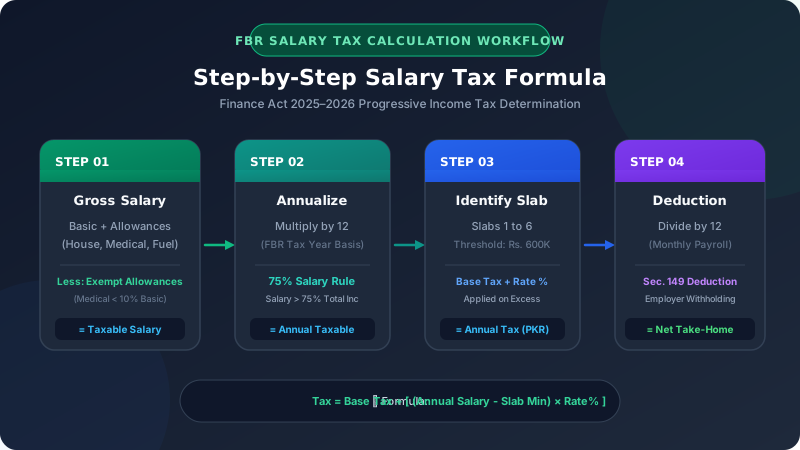
4. 4-Step Mathematical Process to Calculate Salary Tax
Follow this standardized 4-step procedure adopted by corporate HR and payroll departments across Pakistan to compute your tax liability:
Step 1: Calculate Net Monthly Taxable Salary
Take your monthly Gross Salary and deduct the legally exempt portion of your medical allowance:
Monthly Taxable Salary = Gross Salary - (Exempt Medical Allowance up to 10% of Basic)
Step 2: Annualize Your Taxable Salary
In Pakistan, the tax year runs from July 1 to June 30. FBR tax rates are defined on an annual income basis. Therefore, multiply your monthly taxable salary by 12:
Annual Taxable Income = Monthly Taxable Salary × 12
Step 3: Locate Your Applicable FBR Tax Slab
Compare your Annual Taxable Income against the official 6 progressive brackets defined by the Finance Act. Each slab specifies a Fixed Base Tax and a Marginal Percentage Rate applied only to the income exceeding the lower threshold of that slab.
Step 4: Compute Annual Tax and Monthly Payroll Deduction
Apply the standard algebraic formula:
Annual Tax = Fixed Base Tax + [ (Annual Taxable Income - Slab Minimum) × Marginal Rate % ]Monthly Tax Deduction = Annual Tax ÷ 12
5. Current FBR Progressive Salary Tax Slabs Schedule
The table below summarizes the statutory tax brackets for salaried individuals applicable for the current fiscal period:
| Slab | Annual Taxable Income (PKR) | Base Tax | Rate on Excess |
|---|---|---|---|
| Slab 1 | Up to Rs. 600,000 | Rs. 0 | 0% (Tax-Free) |
| Slab 2 | Rs. 600,001 to Rs. 1,200,000 | Rs. 0 | 5% of amount > 600,000 |
| Slab 3 | Rs. 1,200,001 to Rs. 2,200,000 | Rs. 30,000 | 15% of amount > 1,200,000 |
| Slab 4 | Rs. 2,200,001 to Rs. 3,200,000 | Rs. 180,000 | 25% of amount > 2,200,000 |
| Slab 5 | Rs. 3,200,001 to Rs. 4,100,000 | Rs. 430,000 | 30% of amount > 3,200,000 |
| Slab 6 | Exceeding Rs. 4,100,000 | Rs. 700,000 | 35% of amount > 4,100,000 |
6. Real-Life Case Study #1: Calculating Tax on Rs. 125,000 Monthly Salary
Consider an Assistant Marketing Manager working in Lahore with the following official monthly salary slip details:
Employee Compensation Package:
- Basic Salary: PKR 80,000
- House Rent Allowance (45%): PKR 36,000
- Medical Allowance (10%): PKR 8,000
- Utility Allowance: PKR 1,000
- Gross Monthly Salary: PKR 125,000
Step-by-Step Calculation:
- Exempt Medical Allowance: Under Clause 139, medical allowance up to 10% of Basic Salary is exempt. 10% of PKR 80,000 = PKR 8,000. Since the employee receives exactly PKR 8,000, the full medical allowance is exempt from tax!
- Monthly Taxable Salary: PKR 125,000 - PKR 8,000 = PKR 117,000 per month.
- Annual Taxable Income: PKR 117,000 × 12 = PKR 1,404,000 per year.
- Applicable FBR Slab: PKR 1,404,000 falls in Slab 3 (PKR 1,200,001 to 2,200,000).
-
Applying Formula:
Base Tax = PKR 30,000Amount Exceeding PKR 1,200,000 = PKR 1,404,000 - PKR 1,200,000 = PKR 204,000Marginal Tax = 15% of PKR 204,000 = PKR 30,600Total Annual Tax = PKR 30,000 + PKR 30,600 = PKR 60,600 per year - Monthly Payroll Deduction: PKR 60,600 ÷ 12 = PKR 5,050 per month.
- Net Monthly Take-Home Pay: PKR 125,000 - PKR 5,050 = PKR 119,950.
7. Real-Life Case Study #2: Calculating Tax on Rs. 350,000 Executive Salary
Now examine a Senior Software Engineering Director in Islamabad with a gross compensation of PKR 350,000 per month:
Executive Compensation Structure:
- Basic Salary: PKR 220,000
- House Rent Allowance: PKR 100,000
- Medical Allowance: PKR 22,000 (Exempt 10% cap)
- Special Allowance: PKR 8,000
- Gross Monthly Salary: PKR 350,000
- Taxable Monthly Salary: PKR 350,000 - PKR 22,000 = PKR 328,000.
- Annual Taxable Income: PKR 328,000 × 12 = PKR 3,936,000.
- Applicable FBR Slab: PKR 3,936,000 falls in Slab 5 (PKR 3,200,001 to 4,100,000).
-
Applying Formula:
Base Tax = PKR 430,000Amount Exceeding PKR 3,200,000 = PKR 3,936,000 - PKR 3,200,000 = PKR 736,000Marginal Tax = 30% of PKR 736,000 = PKR 220,800Total Annual Tax = PKR 430,000 + PKR 220,800 = PKR 650,800 - Monthly Payroll Tax: PKR 650,800 ÷ 12 = PKR 54,233 per month.
- Net Monthly Take-Home Pay: PKR 350,000 - PKR 54,233 = PKR 295,767 (Effective tax rate: 15.5%).
8. Employer Withholding Tax Under Section 149: How Payroll Deducts It
Under Section 149 of the Income Tax Ordinance 2001, every employer (whether public or private limited company) is legally mandated to deduct income tax at source from the monthly salary of each employee.
Key payroll compliance rules you must be aware of:
- Average Rate Computation: The employer estimates your total annual taxable income for the entire fiscal year, calculates the total annual tax liability, and divides it equally over the remaining months of the tax year.
- Salary CPR (Computerized Payment Receipt): Employers must deposit all deducted withholding tax into the government treasury via National Bank of Pakistan (NBP) or State Bank using an official e-challan (CPR) under Section 149 by the 15th of the subsequent calendar month.
- Annual Withholding Tax Certificate (Section 164): At the conclusion of the fiscal year (after June 30), your employer is obligated to issue an official Salary Tax Deduction Certificate. You will need this certificate when submitting your personal Income Tax Return on the FBR Iris portal.
9. Legal Methods to Reduce Your Salary Tax in Pakistan
While progressive income tax rates are high, the Income Tax Ordinance provides several legitimate tax credits and restructuring provisions to reduce your payable tax:
- Voluntary Pension Scheme (Section 63): Contributions made to an SECP-approved Voluntary Pension Scheme (VPS) qualify for a direct tax credit. You can save up to 20% of your annual taxable income by investing in an approved pension fund.
- Donations to Approved Non-Profit Organizations (Section 61): Donations made via crossed banking cheques to institutions listed in the Second Schedule or approved non-profit organizations qualify for a direct proportional tax credit of up to 30% of your taxable income.
-
Adjusting Advance Withholding Taxes: When you file your annual tax return on FBR Iris, you can adjust advance taxes already deducted throughout the year against your final liability:
- Advance Tax on Mobile Recharge (Section 236): 15% tax deducted on every prepaid card load or postpaid bill.
- Domestic Electricity Bills (Section 235): Advance tax on commercial or residential electricity connections.
- Motor Vehicle Registration & Token Tax (Section 231B/234): Annual vehicle token tax and registration withholding.
- Cash Withdrawals & Banking Transactions (Section 236Y): Advance taxes deducted on non-filer transactions or international card spends.